UX Design Studio – Spring 2020
Objective
Create or modify an existing activity tracker application that links to a basic wearable device, empowering users to live healthier lives, rather than cheat the system.
Challenge
Altering the user’s mental model.
Individual Contributions
This project consisted of me and my partner. Together we research, sketched, and ideated. Although I’m not the best at sketching and making things look organized. I was able to contribute in different ways. I conducted two phone interviews with people in our user group. I was then able to organize that data and pull out significant trends that we could use to start designing. From there we both individually sketched followed by a testing protocol. We wrapped up the project with documentation where we both reflected on the design process.
Target Users
Based on the problem assignment, we wanted to focus on the age group of users with the highest healthcare costs. This would enable us to understand their motivation for working out, or lack thereof, and how we could best make changes to the Fitbit app in order to decrease the amount of “fake outs” and increase the amount of honest activity.
Secondary Research
Secondary research was crucial in me and my partners process of finding a solution. There are so many fitness apps and motivators out there in the world, I didn’t know how to set mine apart from others. First, I asked adults if their workplace implements any good graces for exercise. Luckily I got a lot of different responses. University of Iowa awards their employees with half-off gym membership if they use the gym four times a month. They also get sixty dollars for survey completion. I found out at other places of work employees can get points for taking the stairs instead of the elevator, and parking far away to take more steps. Every company is different in trying to make sure their employees get a little bit more active each day. Lastly, I looked into the FitBit app itself and its features. FitBit has a feature where you can follow channels in a ‘community’ setting online. I thought this seemed like an issue because some users might become discouraged if they weren’t reaching their goals and others were. This led me to my first few sketches and I was ready to tackle this problem.
Primary Research + Interviews
Listed below is my very first interview protocol. My partner and I devised these questions inspired from our secondary research.
USER INTERVIEW
- How the app is currently being used.
- What are the current features that you use the most and why?
- Are you part of any communities within the fitbit app? Do you find these to be helpful?
- If so, how do you use them?
- Do you use the features such as competitions with friends? Do you find these features to be motivating? Do you find them to be detrimental in any way?
- What is something on a health app that you’ve never seen before or would like to be implemented?
- Use of cheating the system
- Have you ever cheated on a goal or workout?
- How did it make you feel?
- How the user measures their own health
- Normally how do you measure your health progress?
- What is your daily step goal (or average steps a day) and why?
- What subtle improvements do you make everyday health wise?
- What is your favorite activity to get a little more movement during the day?
- How do you make sure you get in some activity (even if it’s just a little)?
- Do you workout with friends? Or do you find yourself more active when your peers are around?
- Motivations
- Recall a time when you felt discouraged in your fitness journey. Do you remember why you felt this way?
- Talk about a time when you felt extra motivated to live a healthy lifestyle.
- What keeps you accountable in your fitness journey and everyday life?
- Do you feel that you share the same fitness goals as your peers?
- How do you reach your health and everyday goals?
- Thoughts on new features
- How would you feel about a section on the fitbit app where you could read about small steps you could take each day to improve your health?
- What is your opinion on reminders from your fitness tracker about movement?
- How would you feel if the app kept track of your progress, such as lowered resting heart rate, increased amount of time walking, increased walking pace etc
- How would you feel about a personalized fitness experience rather than the experience focused on you against other users?
- How would you feel about an integrated food logging system within the fitbit app to help track your overall health?
Here are some trends and feedback that we uncovered.
Both Bob and Lauren used a community or sharing feature on their wearables. At first it used to be a highly used feature, but both of them quickly distanced from it. They realized seeing other people’s fitness journeys wasn’t really motivating them, but instead was discouraging at times. For example, Lauren has a friend who is a fitness instructor, seeing that progress bar made her feel discouraged. Instead both users wished they app was more personal. They would like to enter and track their own goals, including eating habits. They both admitted to cheating on a goal or two, it did not make them feel very good. These individuals both value their health and fitness progress so anything to keep them motivated they are open to. Since both Bob and Lauren work full-time jobs sometimes it is difficult for them to meet their goals. Both admitted to walking around the office or parking far away just to get in some extra steps, since getting to the gym might be hard at times. Specifically, we asked what motivated them and why. Along with if they’d like to see competitions amongst themselves and others. The feedback we got was similar, both Bob and Lauren enjoy competing with themselves and would like a more personalized experience.
Final Prototype

Design Rationale
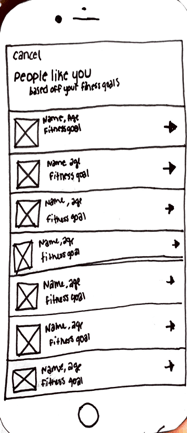
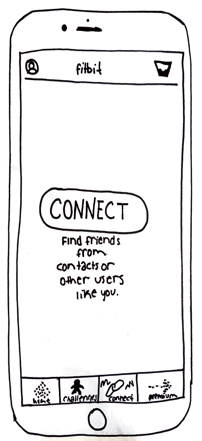
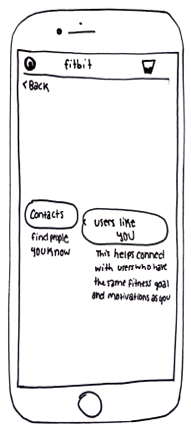
We decided that in order to change the mental model of the user, we wanted to make the app more user focused. We would do this by removing the community feature of the app in order to remove unrealistic fitness goals from the app. We also found this feature in the app to not be a useful part of the app due to the lack of interaction with posts and how old the posts on the page were. We also wanted to conduct primary research on the friends’ section of the app where users could compete against friends and figure out how useful that feature was in motivating the users. Overall, we wanted to make the app more personal to the user to focus on themselves by adding features such as more relevant goal setting and the ability to plan ahead.
Reflection and Summary
Project 1 was my first user based project. I really had to think outside the box to think of solutions and stick to a schedule to reach my goals. Overall, I am happy with my performance and outcome. No design process is the same and I’ve discovered that solving problems is my passion. From project 1 I learned to be flexible and let the outcome take you where it wants. In such small time constraints there is no reason to get stressed or bogged down, one solution is better than no solution. Going into project 2 I am going to try to sketch everyday. This is a skill I struggle with and I want my teammates to understand my ideas. I can’t wait to see what project 2 has in store and I’m sure the solution is out there somewhere.
 Ellie Kouba - Resume