Overview
Ride-sharing companies such as Lyft have become some of the fastest-growing companies in the marketplace. These companies utilize ratings from users as a way to properly award contractors that provide good service and be made aware of those drivers that are not up to standard. The current rating system requires riders to rate their ride on a five-star scale and encourages them to rate using only very good or very bad rankings.
Problem Space
Interviews demonstrated to us that the problem with Lyft’s current rating system is riders’ rating have no good reasoning to back up the choice. Drivers are often unable to tell what they did incorrectly to deserve a poor rating, and they often find themselves struggling to keep a good overall rating. We, therefore, chose to focus on the failure of the Lyft rating system to provide drivers with adequate and specific feedback.
Goals
- Create a way to provide explicit feedback for drivers while also maintaining a simple solution for users
- Drivers gain an understanding of passenger experience and can improve their rides.
Research
Secondary Research
In the beginning, we did not know how to approach the problem space, as we failed to understand what type of issues arise from 5 star rating systems. Our initial understanding of 5 star rating systems was that they were “fair”; 3 stars is the perfect midway point between bad service and exceptional service. In order to gain a better understanding of the problem space, we focused a part of our research to find information on how the current rating system affects drivers in the ride sharing industry, and the impact on the dynamics between drivers and their passengers.
It became apparent that there is a massive misunderstanding of what a good rating is. Ride sharing companies expect only 5 stars, which results in “rating inflation”. Lyft specifically expects their drivers to maintain a 4.79 rating, and anything below that over a period of time can result in suspension. One driver stated, “Most passengers don’t understand Uber rating system. They are led to believe Yelp style rating. With Uber anything less than 5 stars is a failure.” (Raval & Dourish, 2016). Given this insight, we were able to better understand how subjectivity and variations in ideas of what a good rating is affects drivers.
One study researched how the rating system creates a rift between drivers and their passengers, resulting in feelings of distrust (Raval, 2016) . The drivers were asked about the “effectiveness of the rating system as a means to promote trust between passengers and drivers”, and over 45% of the drivers gave it a “‘1’, indicating very poor” (Raval, 2016). Not only are the dynamics between passengers and riders affected, but also the dynamics between those who work for ride sharing companies and the companies themselves. Drivers, especially those who depend on ride sharing programs for their livelihood, are at risk for no work if they fall below certain ratings, which some see as unfair. When asked what type of changes they wanted to see in the rating system, a driver stated, “Either change to a simple “would you ride with this driver again?” question, or require them to say WHY they gave less than 5 stars and give that feedback to the drivers.” (Raval, 2016). This was perhaps one of the most important insights; a binary rating system that also provides useful feedback is seemingly an ideal rating system. With this research, we began to iterate possible solutions.
Primary Research
As stated above, secondary research gave us an insight on how we would frame our problem space. According to an article by “Business Insider” the problem with the current five-star rating system is that it does not give drivers specific feedback. Drivers do not have a way of reading their passenger’s mind, thus struggling to interpret the ratings. This information led us to pursue drivers for our primary research. We wanted to know what their perspective was like behind the ratings, and what they feel is flawed currently. As someone who has never used Lyft before the app is pretty straight forward.
During the weekend we rode in six Lyfts, all of which had five-stars. Conducting questions and gaining information was rather difficult. Drivers either did not have an opinion, there was a language barrier, or there was a lack of mutual understanding. Taking five-star Lyfts maybe was not the way to go, because five-stars mean drivers have nothing to critique on. Luckily we got in contact with a Lyft and Uber driver, Terry Huntley. Terry is the aquatics director at Purdue University and has been driving for Lyft and Uber for two years. He was able to provide us some insights about the driver side of both apps, what he likes and what he doesn’t like.
Interview Protocol
Goals:
- Gain insight on the driver side
- Figure out a preferred method of rating
- Discover Lyft driver-specific goals
Questions
- What is your average rating on Lyft?
- Why do you think that is?
- Are you satisfied with most of the ratings you receive from passengers?
- Why or why not?
- What is something you wish you could ask your passengers about their experience?
- Are you happy with the current rating system of Uber?
- Why or why not?
- If you were to change the current rating system what would change and why?
- What does 5-stars translate to you?
- Excellent, average, the standard?
- What aspects of the ride/experience do you think passengers mainly rate?
- What are three categories you personally would like to be ranked on?
- Cleanliness, conversation, driving, etc.
- What is one thing as a driver that you think you can improve on to boost your ratings?
After conducting an in-depth interview with Terry we started to see some trends. Drivers in fact do get suspended from the Lyft system if they don’t obtain a high star rating. High star meaning four to five. “I could have 100 five-star rides, and out of nowhere I get dinged, what the heck. What was that for?” Out of all his most recent trips Terry has 470 5-star ratings, fifteen 4-star ratings, six 3-star ratings, and nine 1-star ratings. “My stats show me that sometimes rider expectations are different, that’s the frustrating part I can’t control.” We took this into account when creating our initial solution, since passengers don’t always have the time to write a narrative about what was good and what was bad. Before conducting interviews we set a goal to discover and gain insight from the drivers perspective. Terry does not like the current rating system because “5-stars is the standard, but people don’t know that, so maybe that’s why I have some low ratings.” He also mentioned with Lyft specifically, the driver rating can be misleading because it’s averaged from the last 100 rides. Versus Ubers rating system is out of the last 500 rides.
Seeing and summarizing these trends first hand helped us circumference our problem space. Our solution needed to be simple, detailed, and for the drivers benefit.
Design Rational
My team and I based our design decisions on whether they would fit into the problem space we found. Our problem space was fueled by our secondary research into the problems with the five-star rating system, with articles such as “Free to Work Anxiously: Splintering Precarity Among Drivers for Uber and Lyft, Communication, Culture and Critique” and “Uber’s Own Drivers Protested The Company’s Policies And Rating System”. The articles we found drove a decision to focus on the lack of feedback drivers’ receive with the current system, as the articles demonstrated.
Our interviews with drivers further shaped the problem space. The problem with the system continuously proved to be the lack of feedback drivers are given to improve. A simple rating out of five-star provides no insight as to what they do wrong or right, and this was demonstrated to us over and over again.
Therefore, we chose to replace Lyft’s current rating system with a system that focused more on giving feedback to the drivers. Our app is focused on the driver as the main stakeholder, but we still had to keep the user in mind. We found in our research that most users of ridesharing apps use them for special trips such as to and from the airport (Dawes, 2016) and therefore we focused on users in a hurry, demonstrated in a scenario.
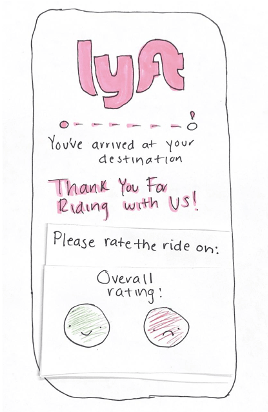
Our final design includes a binary rating system with three categories. Only if the user provides a negative feedback does a scale show to allow the user to further indicate how poor the specific category was.
Upon revisiting our scenarios after completing our final design, we recognized the ways our design solves the issues presented. Adam’s problem of a lack of reliable feedback is solved within our design through providing specific categories for the user to rate the ride on. Natasha’s issue with her overall rating being lowered is solved by removing this rating system and instead issuing a binary one, removing overall rating and simply enabling the driver to better themselves. And lastly, Michael’s issue of a hasty review is resolved with a simple and easy rating system that enables the user to quickly and easily give specific feedback with a few easy taps on the screen.
Final Design

Individual Contributions
This was easily one of my favorite projects. Like previous projects I took the lead in conducting interviews. Together my team and I developed and interview protocol and I took multiple Lyft trips until I felt there was some consistency. Since the trips were relatively fast and I couldn’t get through all the questions I was fortunate enough to interview my boss, Terry. He was able to go further into detail of the research we had already found and was very happy to help. My other contributions included my fair share of documentation and secondary research.
 Ellie Kouba - Resume